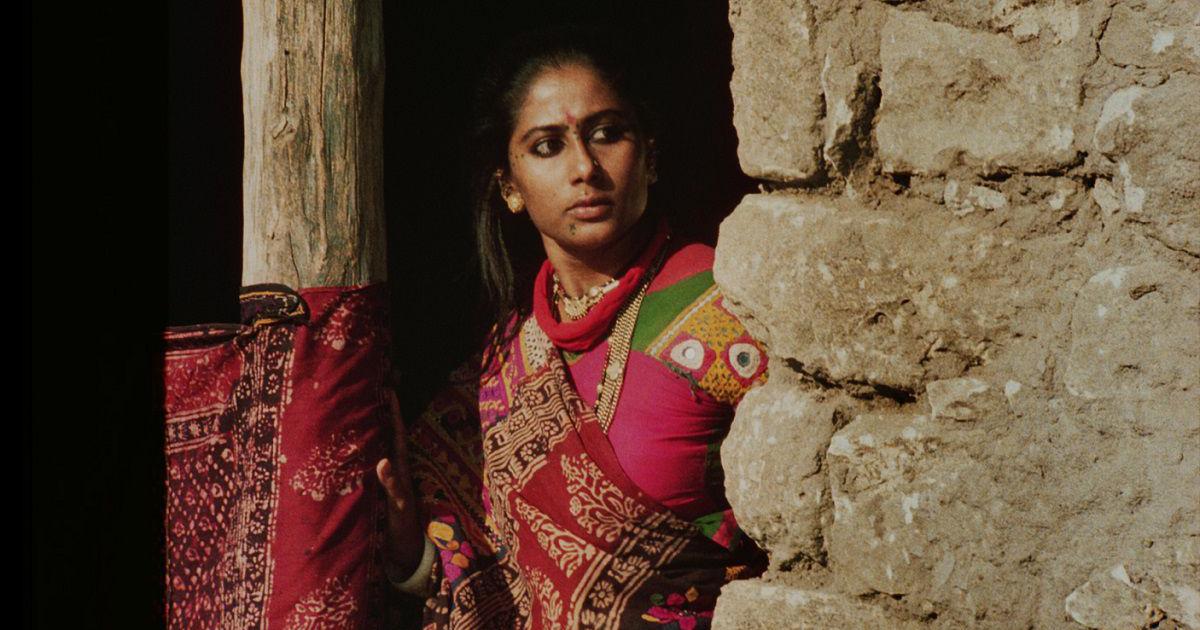
‘Mirch Masala’, the movie which I saw recently, came out in 1987. It’s directed by Ketan Mehta and starred a host of super-talented young actors, many of whom are still going strong even today – Supriya Pathak and Ratna Pathak Shah, some who are unfortunately not seen much on screen – Benjamin Gilani, Mohan Gokhale and my favourite, Deepti Naval and one who is tragically no more- Smita Patil. She quite literally blazes the screen with her performance and her looks.
The story takes place in a village in the Junagadh region of colonial India. An arrogant and lecherous Subhedar is posted there, along with his group of soldiers who ride roughshod over the land and the villagers, plundering at will. The job of the Subhedar is to collect the infamous ‘lagaan’. And no, NO cricket match is played here. In addition to the lagaan, the Subhedar also feels entitled to pick on the village women and SonBai (Smita Patil) takes his fancy. SonBai’s husband has just left for a job in the city and she lives alone. Which makes her fair game.
One day, the Subhedar tries to grope her, she slaps him across his leering face in full view of his soldiers and runs. Enraged, he orders his soldiers to catch her but she manages to escape and takes refuge in a place where chillies are dried and ground into powder. Some women of the village work here and the compound is guarded by an elderly chowkidar, Abu Miyan (Om Puri). He bars the doors and refuses to let the soldiers in or SonBai out. The standoff thus begins and slowly builds up to an unexpected yet fitting climax.
The film is a visual feast of earthy colours and costumes. All the women are dressed in flowing, heavily embroidered ghaghra-cholis that look as exquisite and they are authentic, the men sport turbans and curling moustaches and the Subhedar in his khaki uniform and bowler hat is the picture of evil lust and lechery. The most striking colour is that of the chillies, red and glistening in the sun, they are present in mounds for SonBai to hide behind when the soldiers come in search of her, they carpet the land as the horses ride across them, they slide through the fingers of the village women who spread them out to dry in the sun. In one scene they become like flowers which the women playfully throw at each other, laughing all the while.
The film is a mirror to the patriarchy that existed in those times. Girls don’t go to school, men lounge in the shade while women fetch water from the lake, the Mukhi (Suresh Oberoi) has a mistress because that is expected of him, while his lovely wife (Deepti Naval) is ignored and treated like a chattel. The Subhedar demands that the villagers hand SonBai over to him or he will let his soldiers loose. And the Mukhi summons all the men in the village to decide what should be done. The irony is stark- the men decide that the woman should be handed over to the Subhedar. The priest feels that she should sacrifice herself to save the village. The school teacher (Bejnamin Gilani) who speaks out against this decision is beaten up.
Amid all this is SonBai who stands tall and defiant, refusing to submit. ‘Main nahin jaungi’ is her answer to every threat and plea. At one point she retorts that even if her husband had told her to go, she would have refused. When the women who are locked up in the compound with her, taunt her to get her to leave she defies them too. They tell her that she must have ‘asked for it’ (yes, women can be patriarchal too) she denies it. When they tell her the fault lies in her looks, she says that the fault was in the way the Subhedar looked at her. Three cheers!!
The climax is almost operatic in nature. The deadline has passed and the Subhedar orders his soldiers to ram open the gate of the compound. On the other side, the elderly chowkidar says his final prayers before taking up his rifle. The women brace themselves for the worst and hide in corners and rooms. SonBai arms herself with a sickle. The door crashes open and Abu Miyan is shot down. And then the Subhedar enters to claim his prize.
It reminded me of the ending in Padmavat. When Alla-uddin Khilji enters the fort, all he sees are burning flames. But when the Subhedar enters, he is met by heap after heap of fiery red chilli powder being flung in his face by women who suddenly,spontaneously decided to fight their fate, not submit to it. Flames that leave him writhing on the ground, screaming in agony as SonBai stands there unmoved, the sickle still in hand.
And that’s one way of dealing with patriarchy!
 butterfliesonmymindblog