
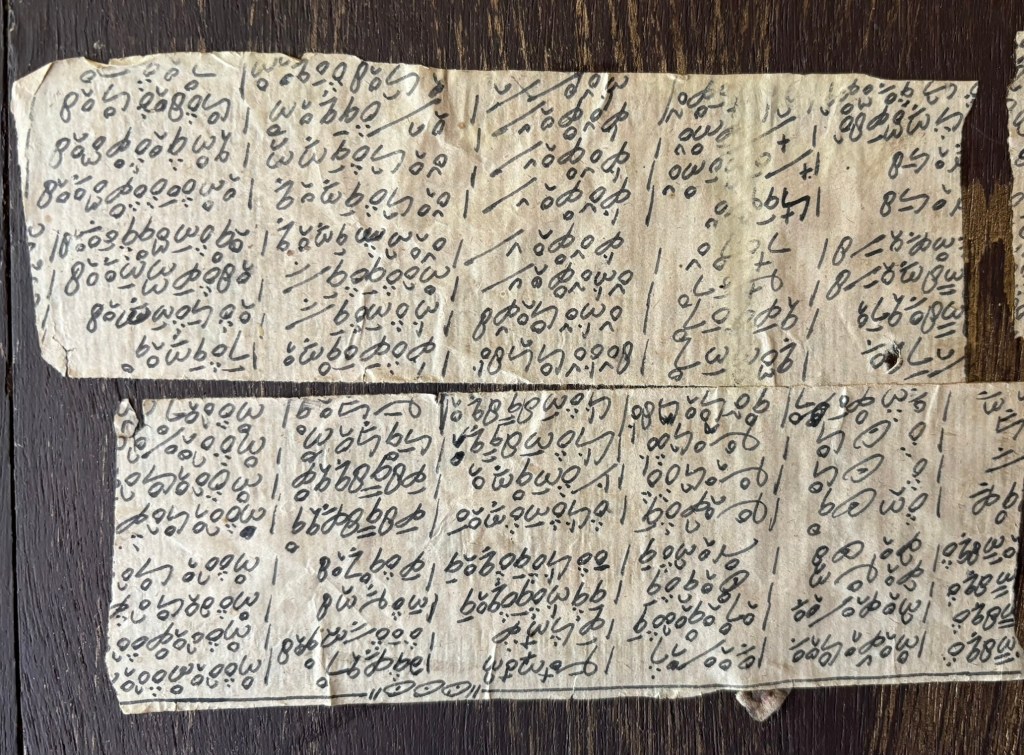
These mysterious looking squiggles on yellowed paper were pasted on the wall of our resort in Pahalgam. At first glance, I thought they were the usual post-its that so many places have on their walls- with comments and messages from guests who have stayed there. But a closer look revealed that this was not the case. It looked like a language but turned out to be some kind of a code. The staff at the resort informed us that it was the code used by the carpet weavers of Kashmir- while weaving those intricate and delicate designs into their carpets.
That did it! Armed with this scrap of information and pictures of those cryptic symbols and signs, I set off down the rabbit hole of the Kashmiri weavers’ code or ‘Talim’ as it is known. Talim, pronounced ‘taleem’ means ‘instruction’ or ‘education’ in Urdu, Arabic and Kashmiri. Very little is known about the origin or history of this archaic code. But it is certain that Kashmiri weavers are the only ones in the world to still use this encrypted language to weave their carpets and shawls.
It was the Sufi saint Hazrat Mir syed Ali Hamdani of Persia, who came to Kashmir in the 14th century; bringing with him Islam and skilled artisans from the Silk Route. The Silk Route or the Silk Roads were a vast network of trade that connected Asia, Europe and Africa over land and sea. These networks dealt not just in merchandise but also became hubs of cultural exchange and centres of learning. Literature, science, crafts, technologies were all imparted here and shared widely along the routes.
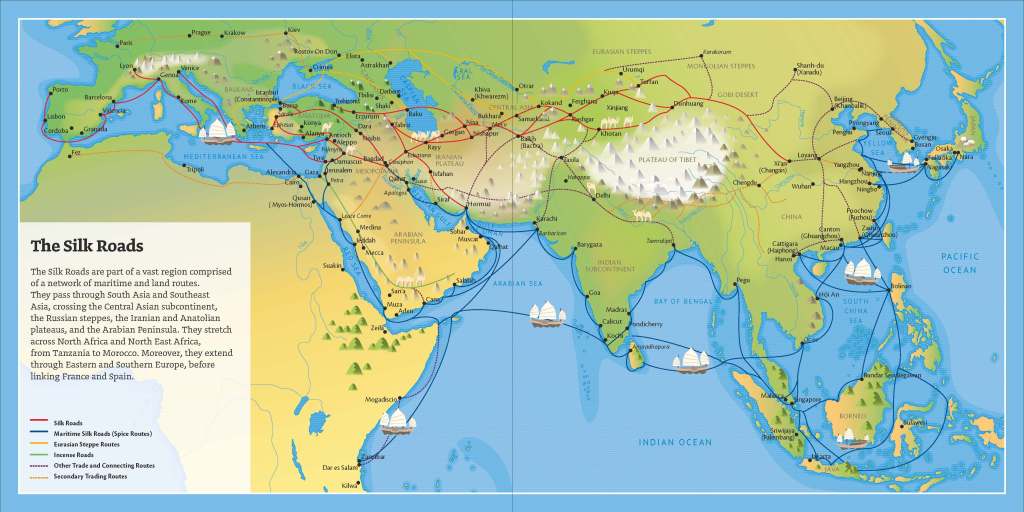
Just think- the squiggles that we see here probably originated hundreds of years ago, on one of these routes. And from there this secret language was passed on till it finally reached the mountains and valleys of Kashmir. Where it still resides and is used by the local weavers to create those exquisitely designed carpets that are made entirely by hand.
To resume, the Talim is like a blueprint for the making of a hand-knotted carpet. But first the size and quality of the carpet has to be decided. Then the design is developed either from the imagination of the designer or from a photograph. This is the task of the ‘Naqash’ or designer. The Naqash divides the paper into 25 sections with each section depicting a knot. The colours to be used are then marked on the design. A carpet with a higher knot count is said to be of better quality.
Next comes the Talim writer who converts this design into the Talim script. The raw material is procured and dyed accordingly. Finally the strips of paper with the Talim written on them are attached to the loom so that the weaver can follow the code and create the pattern. Sometimes the weaver chants the code aloud to himself or gets an assistant to chant the code as he busies himself with the warp and weft on the loom. A fascinating aspect of this process is that the weaver has no idea what the design is. He depends entirely on the Talim. Any error in reading the code could result in a flaw in the design.
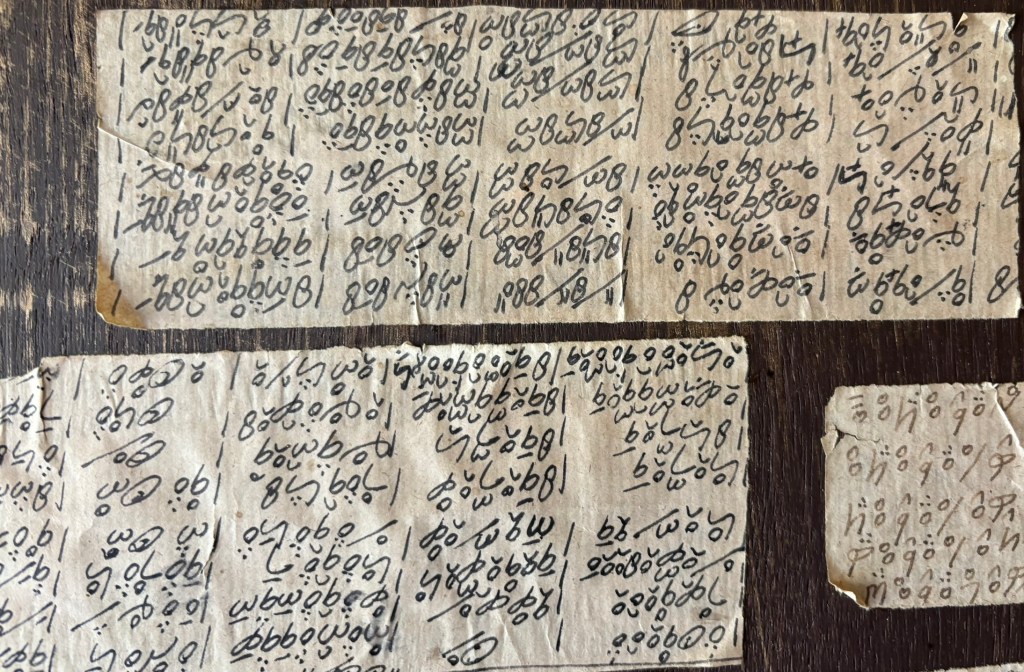
The Talim script has symbols for numbers and colours. For example ‘o’ stands for the colour black and ‘O’ for one knot. Put them together and it means one black coloured knot. I tried my best to decipher the code above but could not find a single black knot anywhere!
Another fascinating aspect of this art form is that the Talim also has terms that enable the script to be read aloud. There are terms that tell the weaver to repeat the colours or the number of knots, to close a design or to use a part of it.
This video also shows why the weaver cannot see the design and has to rely entirely on the reading of the Talim. https://www.youtube.com/watch?v=EBp6OXkDNRs
Like so many ancient, traditional handicrafts, the Talim too is slowly dying out. An art which has been handed down through generations now finds fewer and fewer takers. Here too technology and AI might save the day. There is now a software that preserves these codes and uses them accurately on carpets. (I have mixed feelings about this!) AI will preserve the designs and simplify the process but will it retain the soul of the generations that worked together to create this art and pass it on?
DISCLAIMER: It has been a week since I returned from my trip to Pahalgam and Srinagar and less that a week since that devastating terrorist attack that destroyed lives and livelihoods. I am still trying to come to terms with how fortunate we were to reach home before the strike took place. How can a region that has so much beauty, culture and history continue to remain trapped in this endless cycle of violence and tragedy? It seems that ‘paradise on earth’ will have to find another address. And that will be the biggest tragedy.
 butterfliesonmymindblog